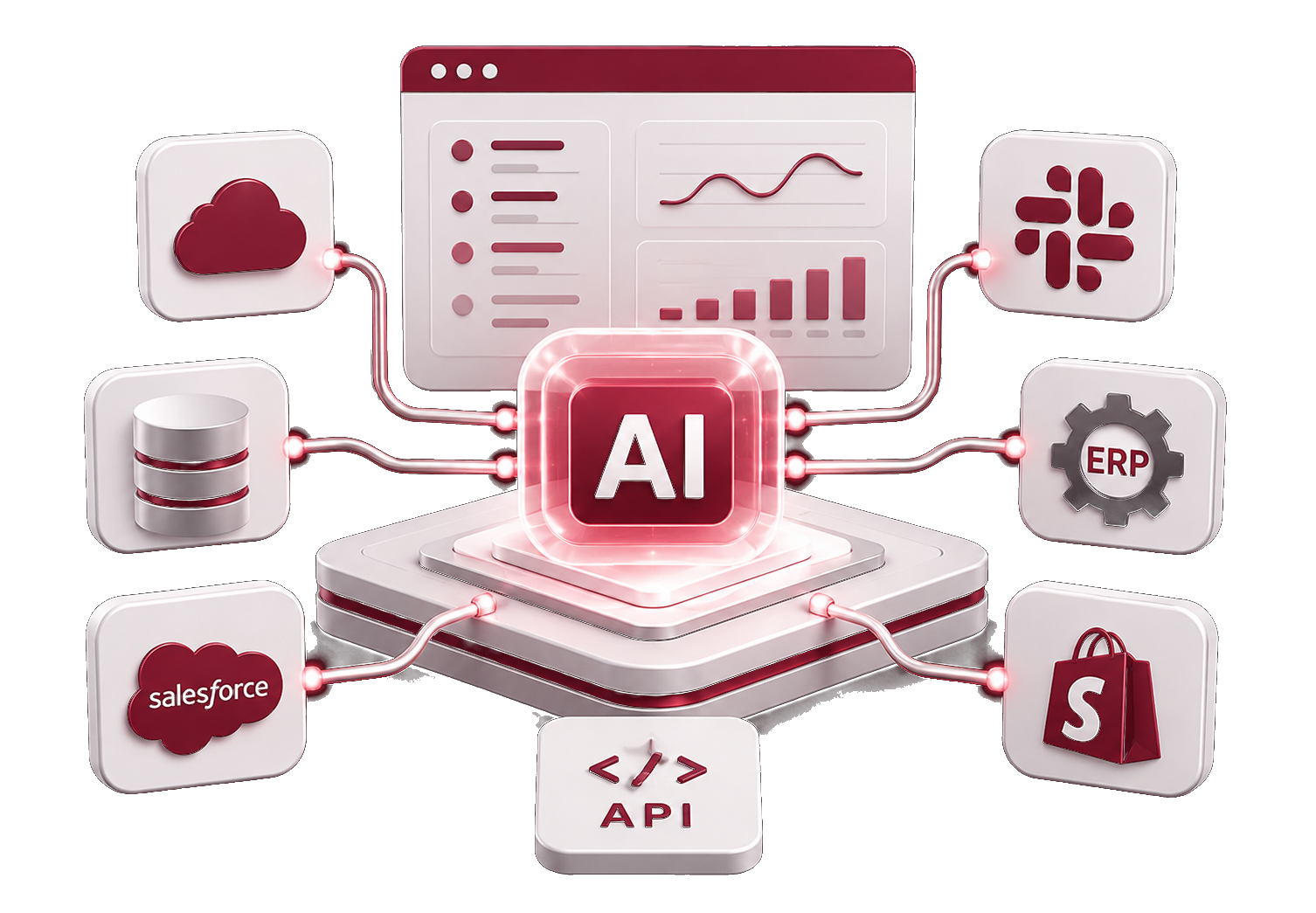
AI Integration Services
Integrate the Latest AI Capabilities Into Your Business
Artificial intelligence is evolving rapidly. Leading AI providers continuously introduce new models, APIs, tools, agents, automation capabilities, reasoning features, multimodal capabilities, and other services that can help businesses complete tasks faster and more efficiently.
However, not every AI requirement needs to be built from scratch.
At CumulativeApps, we help businesses explore the capabilities already available across leading AI platforms before recommending custom development. We research the most suitable options, evaluate their capabilities, limitations, pricing, and integration possibilities, and identify where existing AI services can reduce development time and cost.
Where a provider already offers the capability you need, we help integrate and configure it. Where gaps remain, we develop the missing functionality around it—combining ready-made AI capabilities with custom development to create a solution that fits your business.
When Should You Integrate AI Into Your Existing Business Systems?
You don't always need to replace your existing software or build a completely new AI application. If your current systems already support your core business operations, AI can be integrated into specific areas to improve efficiency, reduce manual work, and give your team better access to information and assistance. AI integration may be worth considering when:
Your Team Spends Too Much Time on Repetitive Work
Important Business Information Is Difficult to Find
Your Existing Software Lacks Intelligent Capabilities
Growing Workloads Are Increasing Manual Effort
Your Employees Need Better Assistance Within Existing Systems
You Want to Improve Efficiency Without Rebuilding Everything
Information Is Spread Across Multiple Business Systems
The right use of AI is not always about replacing your existing systems. Often, it is about identifying specific areas where intelligent capabilities can improve the way your existing business processes work.
Explore Our AI Integration Work
What Our AI Integration Services Include
AI can be added to your existing software and business processes to reduce repetitive work, process information faster, and help your team complete everyday tasks more efficiently.
Read & Process Business Documents
Automatically read invoices, contracts, forms, PDFs, purchase orders, resumes, and other documents to extract, organize, validate, or summarize important information.
Reply to Emails & Customer Messages
Help draft responses, understand incoming emails and messages, categorize requests, and direct them to the right person or workflow.
Find Answers From Your Business Information
Allow employees or customers to ask questions and quickly find information from company documents, policies, manuals, knowledge bases, and other approved sources.
Generate Reports & Business Summaries
Turn business data, documents, meetings, or activities into summaries, reports, insights, and easy-to-understand updates.
Automatically Update Your Business Systems
Use AI to extract or understand information and update relevant records in your CRM, ERP, HR system, database, or other business software.
Review and Organize Incoming Requests
Help identify what an email, customer request, document, or enquiry is about and send it to the appropriate team, person, or next step.
Assist Your Employees While They Work
Add AI assistance inside your existing software so employees can ask questions, prepare content, find information, summarize records, or complete tasks faster.
Listen to and Process Voice Conversations
Convert calls, meetings, and voice recordings into text, create summaries, identify important information, and use the results in your business workflows.
Understand Images and Visual Information
Use AI to analyze uploaded images, photographs, scanned documents, or visual content and extract useful information for your business processes
AI Platforms We Integrate

OpenAI & ChatGPT
Integrate OpenAI's AI models and capabilities into websites, applications, internal systems, and business workflows.

Anthropic Claude
Use Claude for suitable tasks involving reasoning, document analysis, content processing, and other supported AI capabilities.

Google Gemini
Integrate Gemini models and Google's AI capabilities for multimodal processing, intelligent workflows, and business applications.
Open-Source AI Models
Evaluate and integrate suitable open-source models when greater deployment control, customization, or alternative infrastructure options are required.
Specialized AI Providers
Integrate specialized AI services for requirements such as voice, transcription, OCR, image processing, search, and other business-specific capabilities.
Other Emerging AI Platforms
The AI ecosystem changes rapidly. We continuously evaluate relevant new platforms and capabilities to identify technologies that can provide practical value for specific business requirements.
AI Capabilities We Integrate
AI Assistants & Conversational AI
Build AI-powered assistants that can answer questions, retrieve information, and assist users within your website, application, or internal system.
AI Agents & Task Execution
Enable AI to perform multi-step tasks, access approved tools, retrieve information, and interact with connected systems based on defined workflows.
Document Intelligence
Use AI to read, extract, classify, validate, summarize, and process information from business documents.
Voice & Speech
Integrate speech-to-text, transcription, text-to-speech, and conversational voice capabilities.
Image & Visual Understanding
Enable AI to analyze images, scanned documents, and visual information to extract or identify relevant data.
Knowledge & Information Retrieval
Connect AI with approved documents, knowledge bases, databases, and internal resources to help users quickly find relevant information.
AI-Powered Search
Improve search experiences by allowing users to find information using natural language and contextual understanding.
Tool & API Integration
Connect AI with APIs, databases, and business software so it can retrieve information or perform approved actions.
Browser & Computer Interaction
Where supported by the selected provider, integrate AI capabilities that can interact with browser-based or computer environments to perform defined tasks.
Multimodal AI
Combine text, documents, images, audio, and other supported data types within a single AI-powered workflow.
How We Approach AI Integration
Understand Your Requirement
We begin by understanding what you want the AI solution to accomplish, the systems involved, the expected volume of usage, and the business outcome you are trying to achieve.
Research Available AI Capabilities
We explore relevant AI providers, models, APIs, built-in features, tools, and available services to identify the most suitable options.
Compare Cost, Capabilities & Limitations
We compare what different platforms can provide, what they cost, where their limitations are, and whether they are suitable for your expected usage.
Use Existing Capabilities Where They Add Value
If a provider already offers a reliable capability that meets your requirements, we integrate it instead of unnecessarily rebuilding it from scratch.
Develop and Customize What Is Missing
When ready-made capabilities do not fully meet your requirements, we develop the additional
workflows, interfaces, integrations, business logic, and functionality required around them.
This approach can help reduce unnecessary development time while still giving you a solution
tailored to your business.
Use the Best of AI. Build Only What Your Business Needs.
Use proven AI capabilities where they already exist. Build custom workflows, integrations, and business logic where your requirements are unique.
AI Cost Estimation Before Integration
AI Model Selection
Different AI models offer different levels of performance, speed, and cost. We evaluate which model is appropriate for each task instead of automatically using the most expensive option everywhere.
Token & Usage Estimation
We estimate how AI usage may grow based on the expected number of users, requests, documents, conversations, or automated processes.
Multi-Model Strategy
Some workflows may benefit from using different models for different tasks. A smaller or more cost-efficient model may handle routine work, while a more capable model can be used only when necessary.
Prompt & Workflow Optimization
Poor prompt design and inefficient workflows can increase token consumption unnecessarily. We structure prompts and AI interactions to reduce avoidable usage where possible.
Infrastructure & Third-Party Costs
We also consider costs related to hosting, databases, storage, APIs, voice services, OCR, messaging platforms, and other services required by the solution.
Long-Term Operating Cost
Our goal is to help you understand not only the development cost but also the expected cost of running and maintaining the AI solution as usage grows.
Avoid Unexpected AI Usage Costs
Integrating an AI API is relatively easy. Predicting how much the solution will cost to operate at scale requires more planning.
A solution that works well during testing can become significantly more expensive when the number of users, requests, documents, or automated tasks increases.
Before implementation, we help estimate the expected operating costs.
Keeping Up With a Rapidly Changing AI Ecosystem
AI capabilities change quickly. New models, APIs, tools, and platform features are introduced regularly, while existing services continue to improve.
An approach that was expensive or difficult to implement a few months ago may now be available through an existing provider capability. Similarly, a platform that was the best choice when a system was originally developed may no longer be the most suitable option.
We continuously follow developments across the AI ecosystem to evaluate new capabilities that may create opportunities to improve existing solutions, reduce operating costs, or simplify future development.
Our goal is not to use every new AI technology. It is to identify which developments can provide practical value for your business.
Why Partner With Us for AI Integration?
We Research Before We Build
We actively evaluate available AI platforms and capabilities before recommending custom development, helping you avoid rebuilding functionality that may already be available.
Built by an Experienced Development Team
AI integration often requires more than connecting an API. With experience in Python, Node.js, APIs, databases, and custom software development, we can build the additional functionality required around the AI capabilities you choose.
Provider-Agnostic Approach
We are not limited to a single AI provider. We evaluate different models and platforms to identify the best fit for your specific requirements.
Cost-Aware AI Architecture
We consider token usage, model selection, infrastructure, API pricing, and workflow design before implementation to reduce the risk of unexpected operating costs.
Custom Development Where It Adds Value
We use existing AI capabilities where appropriate and focus custom development effort on the workflows, integrations, and functionality that make your solution unique.
Integration With Existing Systems
We design AI integrations that work with your current applications, databases, APIs, and business software wherever technically possible.
Continuously Evolving Expertise
The AI ecosystem changes rapidly. We continuously follow major developments and evaluate relevant capabilities so we can recommend practical improvements when newer technology provides a genuine advantage.
Explore Related Ai Development Services
Frequently asked questions