
Social Commerce Is Changing the Way People Shop
Online shopping used to follow a fairly predictable journey.
A customer had a product in mind, opened Google, searched for it, visited an eCommerce website, compared products, and eventually completed a purchase.
Social commerce is changing that journey.
Today, a customer might discover a product while watching a short video, see a creator demonstrating how it works, read comments from other buyers, ask a question during a live stream, and purchase the product without ever leaving the social experience.
The difference is important.
Traditional eCommerce usually starts with search intent.
Social commerce often starts with discovery.
A person may not have planned to buy anything when they opened an app. But an interesting video, creator recommendation, product demonstration, or live shopping event can turn that moment of discovery into a purchase.
This is why social commerce app development is becoming increasingly interesting for brands, entrepreneurs, marketplaces, and businesses looking to build new digital shopping experiences.
The opportunity is not simply to create another online store.
It is to create a platform where content, community, product discovery, and commerce work together.
What Is a Social Commerce App?
A social commerce app combines social interaction with online shopping. Users can discover products, interact with content, follow creators or brands, and purchase products through the same platform.
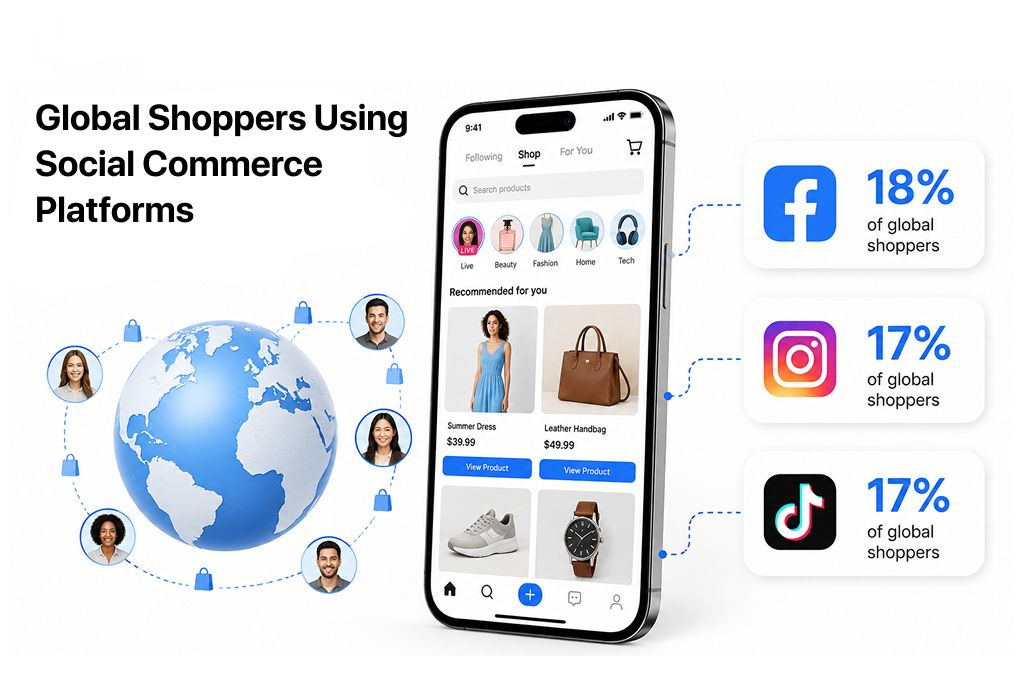
Unlike a traditional eCommerce application, where the primary focus is usually the product catalog and checkout process, a social commerce app puts discovery and engagement at the center of the shopping experience.
Shoppable Posts
Allow users to discover products directly from social content.
Short-Form Videos
Connect engaging video content with product discovery.
Live Shopping
Let users interact with creators and purchase products during live sessions.
Creator Storefronts
Give creators a dedicated space to showcase recommended products.
Product Reviews
Help customers make informed purchasing decisions through real feedback.
User-Generated Content
Turn customer experiences into additional product discovery opportunities.
For businesses considering custom social commerce app development, this model provides an opportunity to build a platform around a specific audience, industry, or shopping behavior instead of relying entirely on existing social networks.
Popular Examples of Social Commerce Platforms
Social commerce is already being used by several major platforms, but each has its own approach.
| Platform | How Social Commerce Works |
|---|---|
| TikTok Shop | Products can be discovered through videos, creators, and live shopping. |
| Instagram Shopping | Brands and creators showcase products through posts, Reels, and Stories. |
| Facebook Shops | Businesses create digital storefronts connected to their social presence. |
| Pinterest Shopping | Product discovery is connected with visual inspiration. |
| YouTube Shopping | Products can be featured within videos and live content. |
| Social interaction, content, and commerce are part of a wider digital ecosystem. | |
| Xiaohongshu (RED) | Users discover products through lifestyle content, reviews, and community recommendations. |
There Is No Single Formula for Social Commerce
One business may focus on creator-led shopping. Another may build a multi-vendor marketplace. A third may focus almost entirely on live commerce. The right approach depends on your target audience and business model.
Why Are Businesses Investing in Social Commerce Apps?
The growing interest in social commerce is not simply about following another technology trend. Businesses are exploring social commerce app development because the way people discover products is changing.
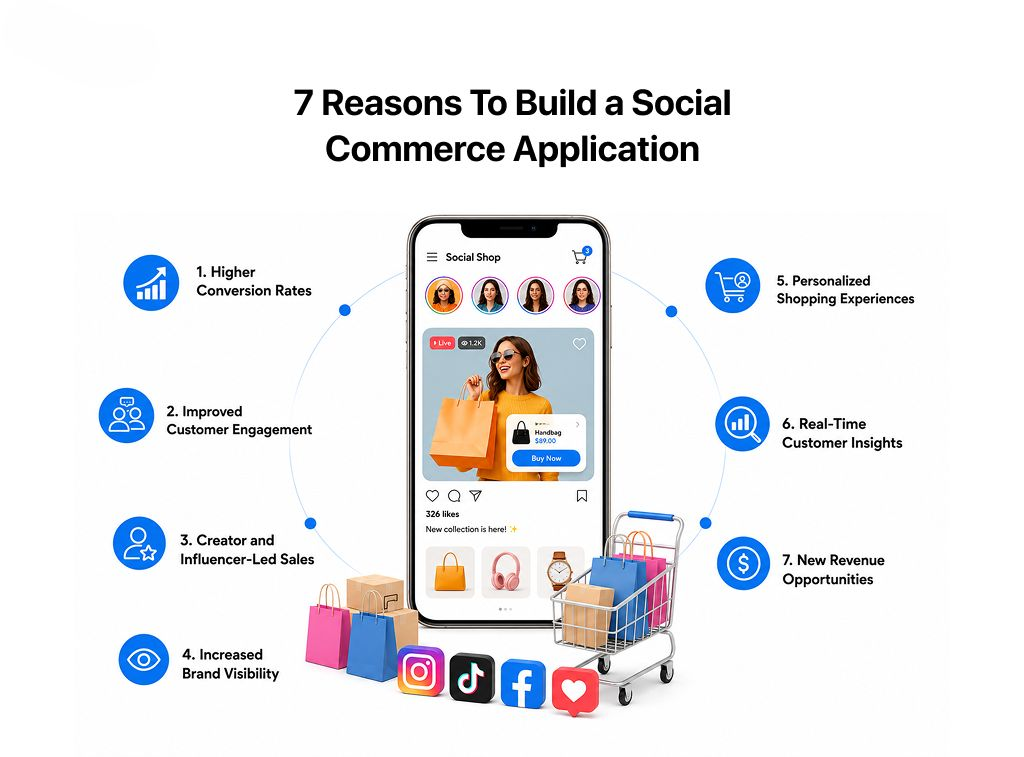
01
Higher Conversion Rates
Every additional step between product discovery and checkout can create friction. Shoppable content, in-app purchasing, and streamlined checkout can create a more direct path from product discovery to purchase.
02
Improved Customer Engagement
Videos, live shopping, reviews, comments, and user-generated content give customers more reasons to interact with the platform and return for new experiences.
03
Creator and Influencer-Led Sales
Creator commerce connects product recommendations with content that audiences already enjoy, creating a more direct relationship between content and commerce.
04
Increased Brand Visibility
Creator collaborations, social sharing, and user-generated content can help products reach audiences beyond a brand's existing customer base.
05
Personalized Shopping Experiences
AI-powered recommendations and personalized feeds can help users discover products that are more relevant to their interests.
06
Real-Time Customer Insights
Businesses can understand which products, creators, and content generate engagement and conversions.
07
New Revenue Opportunities
Businesses can explore affiliate commissions, creator partnerships, live shopping, sponsored content, subscription plans, seller fees, and marketplace revenue.
How to Build a Social Commerce App: Easy Steps
Building a successful social commerce app is not as simple as combining a social network with an eCommerce store. The real challenge is creating an experience where content, community, product discovery, and purchasing work naturally together.
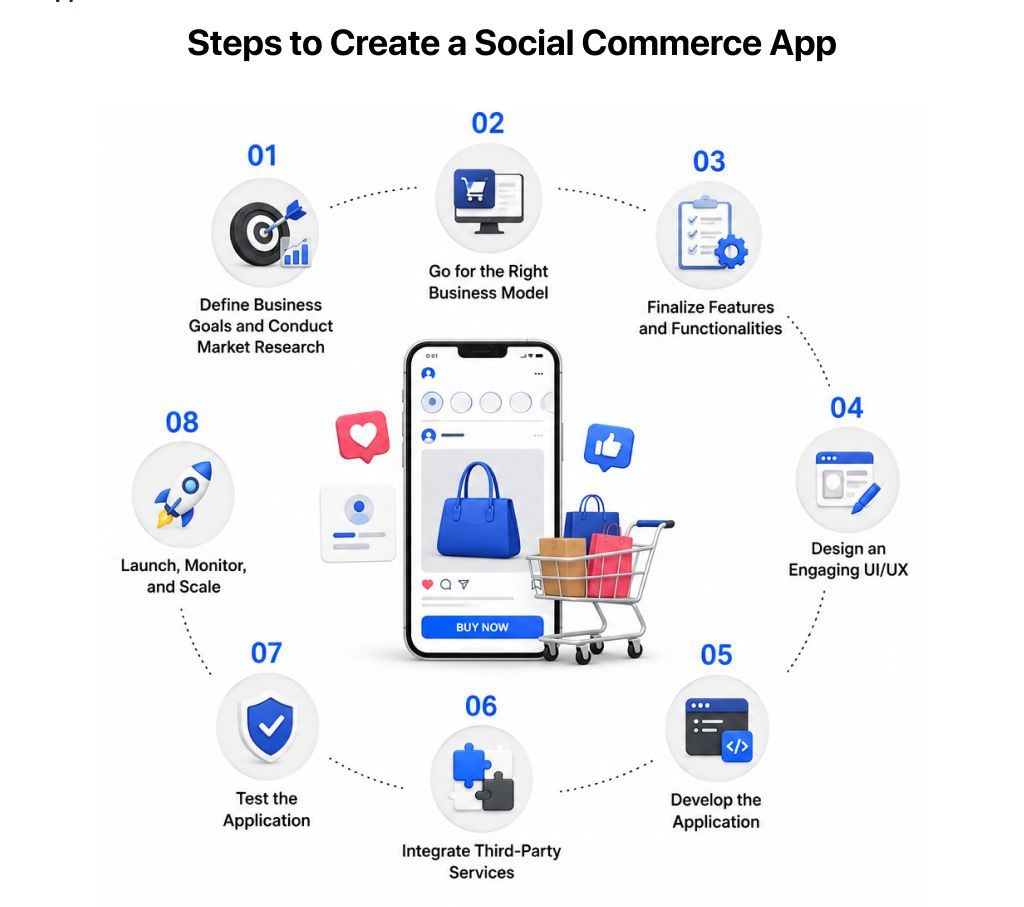
Define Business Goals and Conduct Market Research
Identify your target audience, business objectives, unique value proposition, revenue model, and target market. Study existing platforms to understand user expectations and identify gaps that your platform can address.
Choose the Right Business Model
Decide whether you are building a B2C social shopping platform, multi-vendor marketplace, creator-led commerce platform, live shopping platform, or influencer-focused shopping ecosystem.
Finalize Features and User Roles
Define what customers, sellers, creators, and administrators need to do. Focus on the features that provide the most value for your initial launch and create a roadmap for future improvements.
Design the User Experience
Create a smooth journey from discovery to purchase using user journeys, wireframes, prototypes, and usability testing.
Develop the Application
Build the frontend, backend, database, APIs, commerce functionality, social features, and administrative systems with performance, scalability, security, and flexibility in mind.
Integrate Third-Party Services
Connect payment gateways, shipping providers, live streaming services, analytics platforms, CRM systems, AI recommendation tools, and other required services.
Test the Application
Test functionality, performance, security, usability, compatibility, payment processing, third-party integrations, and real-time features.
Launch, Monitor, and Scale
Monitor user engagement, product interactions, conversion rates, content performance, creator activity, seller activity, and overall platform performance after launch.
Social Commerce App Features in 2026
The right features depend on your business model. A creator-led commerce platform will not require exactly the same functionality as a multi-vendor marketplace.
Customer Panel
| Feature | Purpose |
|---|---|
| Smart Recommendations | Suggest products based on browsing, interests, and purchase behavior. |
| Shoppable Content | Allow users to discover products directly from posts and videos. |
| Live Shopping | Watch live product demonstrations and purchase during the session. |
| Smart Product Search | Find products using search, filters, categories, and sorting. |
| Easy Checkout | Reduce unnecessary steps during purchase. |
| Multiple Payment Options | Support suitable payment methods for target markets. |
| Order Tracking | Allow customers to monitor delivery progress. |
| Reviews & Ratings | Help customers make informed purchasing decisions. |
Seller Panel
| Feature | Purpose |
|---|---|
| Product Catalog Management | Add, edit, and organize products. |
| Inventory Management | Track and update stock levels. |
| Order Management | Manage orders, fulfillment, and cancellations. |
| Promotions | Create discounts, coupons, and special offers. |
| Sales Analytics | Monitor revenue and product performance. |
| Customer Management | View customer information and purchase history. |
| Shipping Management | Manage delivery and shipment information. |
| Returns & Refunds | Handle post-purchase requests. |
Creator Panel
| Feature | Purpose |
|---|---|
| Creator Storefront | Showcase recommended products. |
| Product Tagging | Connect products with videos, posts, and live content. |
| Affiliate Management | Track referrals and product sales. |
| Commission Dashboard | Monitor creator earnings. |
| Live Shopping Tools | Host product-focused live sessions. |
| Content Management | Create and manage commerce content. |
| Performance Analytics | Track engagement and conversions. |
| Payout Tracking | Monitor commissions and payment history. |
Admin Panel
| Feature | Purpose |
|---|---|
| User Management | Manage users and permissions. |
| Seller Management | Approve and monitor sellers. |
| Creator Management | Manage creators and partnerships. |
| Product Management | Manage listings and categories. |
| Order & Transaction Management | Monitor payments, orders, and refunds. |
| Content Moderation | Review user-generated content. |
| Business Analytics | Monitor revenue and platform performance. |
| Access Control | Manage administrative permissions. |
One Platform, Four Different Experiences
Customer
Discovers and purchases a product.
Seller
Manages products and fulfills orders.
Creator
Promotes products and potentially earns commissions.
Administrator
Manages the ecosystem connecting everyone together.
The success of the platform depends on how well these different experiences work together. This is what makes a social commerce platform more complex than a standard eCommerce application.
Best Tech Stack for Social Shopping App Development
Technology should be selected according to your platform—not the other way around. The right technology stack depends on your expected traffic, business model, features, integrations, and long-term roadmap.
| Technology Layer | Recommended Technologies |
|---|---|
| Mobile Frontend | Flutter, React Native |
| Web Frontend | React.js, Next.js, Angular |
| Backend | Node.js, PHP, Laravel |
| Database | PostgreSQL, MongoDB, MySQL |
| Payment Gateway | Stripe, PayPal, Razorpay |
| Authentication | OAuth 2.0, Firebase Authentication, Auth0 |
| Push Notifications | Firebase Cloud Messaging, OneSignal |
Common Challenges in Social Commerce App Development
01. Real-Time Inventory Management
Challenge: Products sold through multiple channels can create inaccurate stock information.
Solution: Use centralized or synchronized inventory management to keep stock information updated.
02. Live Shopping Performance
Challenge: Popular live shopping events can attract large numbers of users simultaneously.
Solution: Use scalable infrastructure and suitable live-streaming technologies.
03. Handling Sudden Traffic Spikes
Challenge: Viral content and creator campaigns can suddenly increase platform traffic.
Solution: Use scalable cloud infrastructure, load balancing, caching, and auto-scaling.
04. Payment Security and Data Protection
Challenge: Social commerce platforms handle personal information and payment transactions.
Solution: Use trusted payment providers, secure authentication, encryption, and appropriate security practices.
05. Creator Tracking and Commission Management
Challenge: Tracking sales across multiple creators can become complicated.
Solution: Build reliable affiliate tracking, attribution, and commission management into the platform.
The Technology Should Support Your Commerce Model
There is no universal formula for building a successful social commerce app.
A platform focused on creator-led shopping will have different requirements from a multi-vendor marketplace. Similarly, a live shopping platform will need different infrastructure from an application focused primarily on shoppable videos and user-generated content.
Before Starting Development, Define:
- Who are your users?
- How will they discover products?
- Who will sell the products?
- What role will creators play?
- How will customers purchase?
- How will the platform make money?
- What should the platform look like after two or three years?
Once these questions are clear, you can build a technology and feature roadmap around your actual business requirements.
The Best Social Commerce Platforms Start With the Right Technology Partner.
Discover how CumulativeApps has helped businesses build scalable, high-growth social commerce apps.